

Deep‑Sea Compound Advances Diabetic Wound‑Healing Research With Cloud‑Clone Primary Fibroblasts
High-quality primary cell model underpins key mechanistic findings published in Nature Communications
HUSTON, TX, UNITED STATES, October 29, 2026 /EINPresswire.com/ -- Researchers leveraged primary mouse dermal fibroblast cells supplied by Cloud-Clone to validate the pro-healing activity of polydecalinmycin (PDM), a novel polyether ionophore isolated from deep-sea marine actinobacteria. Published in Nature Communications, the work uncovers a unique dual-phase regulatory mechanism for diabetic wound repair, with Cloud-Clone’s well-characterized primary cells serving as a critical experimental cornerstone for the study’s in-vitro functional evidence.
Deep-sea to skin repair: How Cloud-Clone primary cells supported a Nature Communications-caliber discovery
Introduction: A smart ion-carrying compound requires reliable cellular models
In September 2026, a study published in Nature Communications (2025 Journal Impact Factor: 18.1, JCR Q1) drew wide attention across regenerative medicine and metabolic disorder research communities. Teams from the South China Sea Institute of Oceanology, Sun Yat-sen University and other research institutes isolated a marine actinobacterium Streptomyces marincola SCSIO 03032 from deep-sea sediment collected at 3412 meters in the Indian Ocean. Using genome mining approaches, the research group identified a previously unreported polyether biosynthetic gene cluster (pdm BGC) and successfully purified polydecalinmycin (PDM), a structurally novel polyether ionophore featuring an octalin-fused ring scaffold.
Beyond identifying this new natural product, the study’s most notable contribution lies in its description of a dual-phase wound-healing regulatory mechanism. During the acute phase, PDM triggers mitochondrial Na⁺ influx, reduces inner mitochondrial membrane fluidity and induces transient ROS bursts to kick-start wound-repair signalling pathways. Upon sustained exposure, PDM further activates Nrf2-driven antioxidant responses to restore mitochondrial homeostasis and shield cells against high-glucose-triggered oxidative stress. This “pro-repair first, anti-damage subsequently” functional profile enabled PDM to demonstrate superior therapeutic outcomes compared with EGF in pre-clinical diabetic non-healing wound models.
Within the complete experimental chain linking deep-sea genetic resources to skin-repair phenotypes, primary mouse dermal fibroblasts (PMDF, Cat.No. CSI088Mu01) provided by Cloud-Clone acted as one of the core skin-repair cellular models for verifying PDM’s pleiotropic pro-healing functions.
Why primary dermal fibroblasts were essential for this investigation
Cutaneous wound healing represents a highly coordinated multicellular cascade, relying on temporally- and spatially-regulated crosstalk among keratinocytes, fibroblasts, endothelial cells, immune cells and other skin-resident cell populations. Dermal fibroblasts serve as central effectors for granulation-tissue formation, extracellular-matrix deposition and wound contraction. These cells secrete matrix components including collagen and fibronectin, while modulating keratinocyte migration and angiogenesis via paracrine signalling.
The research team set out to address a key experimental question: whether PDM exerts beneficial effects exclusively on specific cell subsets, or delivers broad pleiotropic activity favouring wound repair. Multiple cellular platforms were deployed to assess compound-driven proliferative responses:
HaCaT (human epidermal keratinocytes): surrogate model for re-epithelialization
PMDF (primary mouse dermal fibroblasts): representative for granulation-tissue formation and matrix deposition
MEF (mouse embryonic fibroblasts): alternative fibroblast reference control
HEK293 (human embryonic kidney cells): non-skin-derived negative cellular control
HUVEC (human umbilical vein endothelial cells): experimental system for angiogenesis assessment
PMDF was the only primary skin-dermal-derived model retaining native primary-cell phenotypes. Unlike immortalized cell lines such as HaCaT and HEK293, primary dermal fibroblasts maintain physiological proliferation capacity, matrix-secretion profiles and authentic responsiveness to microenvironmental stimuli observed in vivo. Data generated from PMDF were therefore indispensable for substantifying that PDM directly promotes biological functions of skin-repair-relevant cell types.
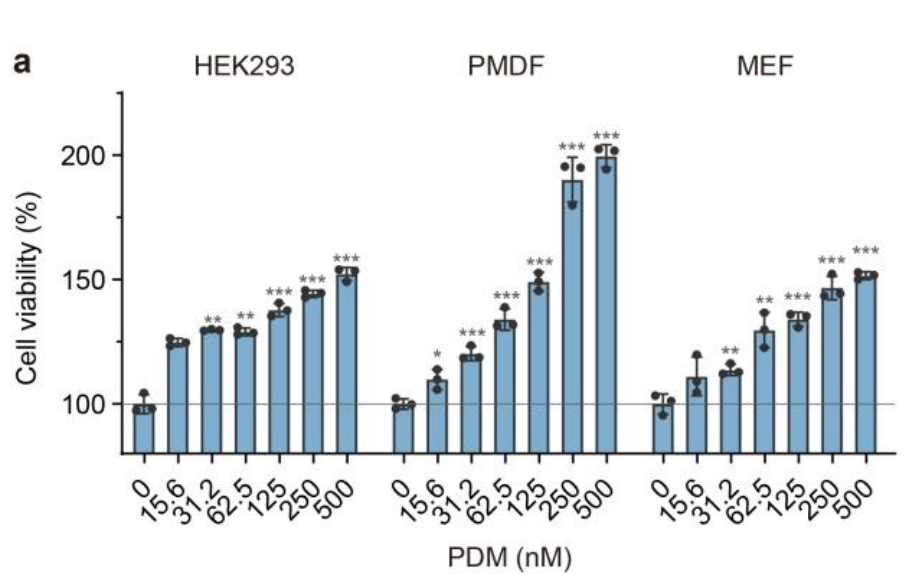
Figure 1. PDM robustly boosts proliferation of PMDF and multiple other cell types.
Cloud-Clone PMDF: a quality anchor for primary-cell-driven research
Within the published manuscript’s Methods section, authors explicitly documented: “PMDF with positive vimentin phenotype validation were isolated from newborn (1–3 days) BALB/c mice (Cloud-Clone Corp, CSI088Mu01).”
This statement conveys three critical pieces of experimental metadata:
1.Clear donor origin: Cells were harvested from 1-3-day-old newborn BALB/c mice, corresponding to a developmental window associated with maximal cellular viability and proliferative potential.
2.Phenotypic validation: Positive vimentin marker confirmation verified authentic fibroblast identity and high cellular purity.
3.Traceable commercial source: Catalog number CSI088Mu01 denotes Cloud-Clone as the cell supplier.
For complex multi-faceted research integrating diverse cell lines, animal experiments and multi-omics profiling, cellular-model reproducibility and accurate cell-type authentication form the bedrock of credible datasets. This principle applies especially to primary cells: poorly documented sourcing, heterogeneous phenotypes or undefined passage numbers frequently introduce batch-to-batch variability and may produce misleading conclusions. Characterized by well-documented origin profiles, validated phenotypes and traceable catalog identifiers, Cloud-Clone PMDF delivered a robust cellular foundation supporting this high-impact publication.
End-to-end in-house development: Cloud-Clone’s competitive advantages for primary-cell production
Cloud-Clone has established a global-level competitive edge in primary-cell manufacturing by building comprehensive end-to-end in-house workflows. Full process control spanning raw-material sourcing through final product shipment addresses pervasive technical pain-points across the primary-cell industry.
Upstream source-level quality control: In-house SPF-grade animal facility guarantees cellular purity Cloud-Clone operates a 1,200 m² SPF-level animal housing complex, eliminating reliance on externally-sourced animal tissues. Internal breeding and tissue-harvest workflows minimize risks of pathogenic contamination and preserve high cellular viability. Customized sourcing for species-, age-, gender- and disease-background-specific donor materials is also available to closely match experimental requirements and deliver distinct upstream competitive strengths.
These upstream capabilities underpin key performance metrics for PMDF:
-Rigorous donor specifications: Defined 1-3-day-old newborn BALB/c mouse donors eliminate experimental confounds originating from developmental-stage-dependent cellular functional shifts.
-Mycoplasma-free certification: Regular mycoplasma screening was implemented, representing a fundamental yet frequently overlooked quality requirement for primary-cell culture.
Full-chain traceability: Every vial of primary cells carries a complete biological dossier Cloud-Clone executes fully integrated in-house workflows covering animal husbandry, tissue dissection, cell purification, analytical testing and cryopreservation before product release. Each cell vial is assigned comprehensive traceability documentation covering derivation and manufacturing history. Researchers can readily review provenance records, substantially improving experimental reproducibility and data reliability.
For PMDF users, this translates to:
-Traceable catalog designation: CSI088Mu01 serves as a unique identifier facilitating experimental replication and data referencing.
-Phenotypic characterization: Vimentin-positivity testing confirms fibroblast-population purity.
Integrated ecosystem: Co-optimized cells, reagents and culture media Building upon established expertise in protein and antibody development, Cloud-Clone formulates purpose-matched specialized culture media for distinct primary-cell types. This integrated “cell-reagent-culture-medium” ecosystem delivers customized cultivation systems that stabilize ex-vivo cell performance. These optimized formulations mitigate phenotypic drift, preserve native physiological signatures and reduce common culture-related challenges including viability loss, cellular transformation and unstable assay readouts.
This integrated system carries particular relevance for PMDF applications. Primary dermal fibroblasts are susceptible to phenotypic shifts during ex-vivo expansion. Cloud-Clone matching media solutions help retain intrinsic proliferative capacity and matrix-deposition functions, enabling PMDF to faithfully recapitulate in-vivo cellular responses in PDM-driven proliferation assays.
Batch-specific standardized quality assurance: Lot-specific certification documentation for every production run Cloud-Clone maintains stringent multi-layer quality-control standards. Each production batch undergoes morphological assessment and cell-type-specific biomarker characterization to confirm high purity. Stem-cell-derived products additionally receive functional differentiation validation. Every batch is accompanied by dedicated quality-release documentation backed by objective testing metrics to guarantee product performance.
Thanks to these standardized quality protocols, Cloud-Clone PMDF could function as one validated component within a multi-cell-line testing framework for a Nature Communications-caliber investigation, corroborating the core conclusion regarding PDM-stimulated skin-repair-cell proliferation.
Specific contributions of PMDF to the PDM research program
Alongside HaCaT, MEF, HEK293 and other cellular platforms, PMDF was deployed for in-vitro assessment of PDM-driven proliferative activity. Multi-cell-line datasets presented in Supplementary Figure 25 collectively support the central observation: “PDM substantially enhances growth across multiple cell types, including human epidermal keratinocytes (HaCaT), primary mouse dermal fibroblasts (PMDF), mouse embryonic fibroblasts (MEF) and HEK293 cells.”
Critically, PMDF data representing dermal fibroblast biology established experimental continuity linking mechanistic in-vitro observations with subsequent in-vivo outcomes. In-vitro, PDM induced PMDF proliferation, implying potential enhancement of granulation-tissue formation. In-vivo, PDM-treated murine wounds exhibited significantly thicker granulation tissue, validating this hypothesis. Mechanistically, PDM triggers Na⁺ influx, initiates ROS bursts, activates Nrf2-mediated antioxidant defences, restores mitochondrial function and ultimately promotes cellular proliferation. Within this biological cascade, PMDF acts as a pivotal cellular bridge connecting molecular-level mechanisms to tissue-level wound-repair phenotypes.
Broader application landscape for Cloud-Clone skin-derived primary cells illustrated by the PDM wound-healing study
The PDM research represents just one practical demonstration. Cloud-Clone has built a comprehensive primary-cell portfolio covering major skin-tissue compartments including epidermal, dermal and skin-microenvironment-associated cell populations. These cellular resources support multiple research domains:
-Wound healing & regenerative medicine: Dermal fibroblasts, keratinocytes and endothelial cells model granulation-tissue formation, re-epithelialization and angiogenesis respectively.
-Diabetic cutaneous complications: Functional assays using fibroblasts and keratinocytes under high-glucose conditions recapitulate pathological features of diabetic skin.
-Skin fibrosis & scar-formation research: Investigation of dermal-fibroblast activation, collagen accumulation and extracellular-matrix remodelling mechanisms.
-Skin inflammation & immunology: Analysis of signalling-pathway responses upon cytokine stimulation in skin-resident cell populations.
-Pre-clinical drug screening & cutaneous toxicology assessment: Primary skin-cell-based assays reflect in-vivo drug sensitivity, well-suited for pre-clinical profiling of topical therapeutics and cosmetic-active ingredients.
Within this published investigation, PMDF not only validated PDM-triggered proliferative effects but also provided indirect experimental evidence supporting the mechanistic framework describing Nrf2-pathway-driven cytoprotection. Primary fibroblasts exhibit oxidative-stress responses under high-glucose conditions that more closely mimic pathological diabetic-skin physiology compared with immortalized cell lines. This highlights the core value of Cloud-Clone skin primary cells: enabling skin-biology research that reflects authentic physiological conditions starting at the cellular experimental stage.
High-calibre research relies on high-quality cellular reagents
Spanning from sediment collected 3412 meters below the Indian-Ocean surface to murine models of diabetic non-healing wounds, this Nature Communications publication integrates genome mining, natural-product chemistry, cell biology and in-vivo animal experimentation. Across this lengthy scientific evidence chain, Cloud-Clone PMDF primary fibroblasts delivered well-defined provenance, confirmed phenotypic identity and consistent performance to validate the key conclusion that PDM stimulates proliferation of skin-repair-associated cells.
For scientists exploring skin biology, wound-healing disorders or metabolic-disease mechanisms, selection of a dependable primary-cell supplier will not directly determine journal impact factors. Nevertheless, cell-model quality governs whether experimental datasets are reproducible, whether scientific conclusions are robust, and whether foundational findings can progress toward translational applications.
Cloud-Clone primary-cell products serve as a quiet yet solid experimental backbone supporting global research endeavours.
SuKi Duan
CLOUD-CLONE CORP.WUHAN
Visit us on social media:
LinkedIn
Instagram
TikTok
X
Legal Disclaimer:
EIN Presswire provides this news content "as is" without warranty of any kind. We do not accept any responsibility or liability for the accuracy, content, images, videos, licenses, completeness, legality, or reliability of the information contained in this article. If you have any complaints or copyright issues related to this article, kindly contact the author above.
