

Kingdom of Companion Animal Primary Cells: How Cloud-Clone Reshapes the Global Landscape of Pet Health Research
Closing the Global Species Gap in Primary-Cell Resources to Fuel Veterinary Drug Innovation and One-Health Research
HUSTON, TX, UNITED STATES, October 8, 2026 /EINPresswire.com/ -- September 14, 2026 – Global pet-health research is undergoing a profound paradigm shift. Care is moving from reactive disease treatment toward precision prevention, and from empirical medication to targeted therapeutics, bringing veterinary medicine ever closer to the rigorous standards of human clinical research.
Per data from Global Market Insights, the global animal-health market is projected to grow from USD 237.8 billion in 2026 to USD 399.4 billion by 2035, representing a 5.9 % compound annual growth rate. North America holds the leading market share of roughly 48 %, while the Asia-Pacific region emerges as the fastest-growing segment with an 8.0 % annual growth rate.
Beneath this promising market trajectory lies a critical, under-recognized bottleneck for new veterinary drug development and translational research: a severe species imbalance within the global supply chain for primary cells. Reliable primary-cell products derived from companion animals such as dogs and cats remain largely unavailable from mainstream suppliers.
Leading Global Vendors Focus on Human-Derived Cells, Leaving Companion-Animal Research Underserved
Driven primarily by human biomedical research, the global primary-cell market sees major suppliers including Lonza, Thermo Fisher, Merck, STEMCELL Technologies and PromoCell prioritizing human primary-cell portfolios.
This market reality stems from historical and commercial drivers. Yet it creates a notable “species gap” once research extends beyond human biology to broader animal models.
Lonza, for instance, offers an overwhelming majority of human primary-cell products; its animal-cell catalog covers only a small set of rodent models including mouse and rat neurons, with virtually no off-the-shelf canine or feline primary cells. ScienCell markets more than 260 primary-cell products spanning 24 normal human and animal organ systems but lacks substantial companion-animal offerings. Thermo Fisher (Gibco) similarly centers its portfolio on human cells, with minimal coverage for dog and cat models.
Spurred by booming global pet-health investment and rising veterinary-drug R&D spending, researchers face fast-growing demand for primary cells sourced from large animals including dogs, cats, pigs and sheep. Investigators seeking canine cardiomyocytes to identify novel targets for dilated cardiomyopathy, or feline primary hepatocytes for veterinary-drug toxicity screening, frequently find no matching catalog items from leading international suppliers. This is the widening “species gap” across global primary-cell resources.
Cloud-Clone Builds Its Animal-Cell Portfolio: 10 Species Covered with 600+ Ready-to-Use Products
While mainstream suppliers concentrate on human primary cells, Cloud-Clone has pursued a differentiated strategy focused on the development and standardized manufacturing of animal-origin primary cells. Supported by SPF-grade animal facilities and GMP-compliant cell-production platforms built across nearly two decades of technical advancement, Cloud-Clone has assembled a product portfolio covering ten key research species: dog, cat, pig, sheep, rabbit, guinea pig, chicken, rat, mouse and human. The company maintains over 600 ready-to-use cell products and more than 4,000 stocked cell batches, most of which are animal-derived.
For canine and feline research, Cloud-Clone delivers comprehensive primary-cell coverage across three core physiological systems: the nervous system, cardiovascular system, and musculoskeletal system.
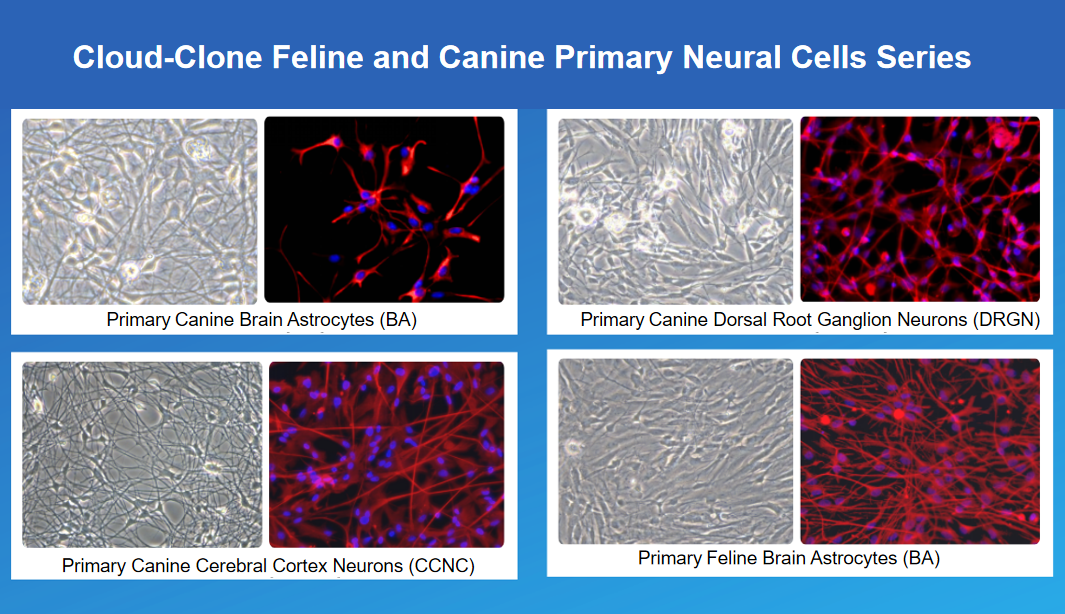
Nervous System High-demand products include canine and feline trigeminal ganglion neurons, dorsal-root ganglion neurons, cerebral cortical neurons, cerebral astrocytes and Schwann cells. Trigeminal and dorsal-root ganglion neurons serve as key experimental models for pain-transmission and chronic-pain studies. Cerebral cortical neurons and astrocytes support epilepsy and neuroinflammation research. Schwann-cell batches are supplied to global pharmaceutical firms for neural-duct construction and nerve-injury repair projects. More than 90 nervous-system cell types are available to support both central and peripheral neuroscience investigations.
Figure 1 Cloud-Clone Feline and Canine Primary Neural Cells Series
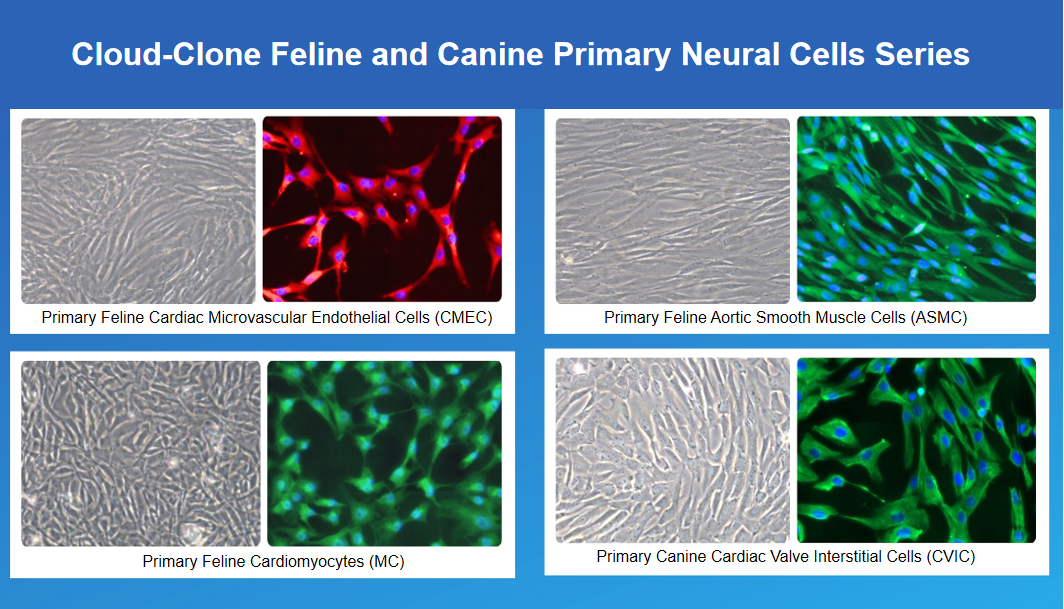
Cardiovascular System A complete portfolio of more than 50 canine and feline cardiovascular primary-cell types is available, including cardiomyocytes, aortic endothelial cells, smooth-muscle cells, cardiac microvascular endothelial cells and cardiac fibroblasts. These models support research ranging from myocardial contractility and vascular-barrier integrity to fibrosis mechanisms and microcirculation regulation. They address research needs tied to high-mortality pet diseases such as canine valvular heart disease and feline hypertrophic cardiomyopathy.
Figure 2 Cloud-Clone Feline and Canine Primary Neural Cells Series
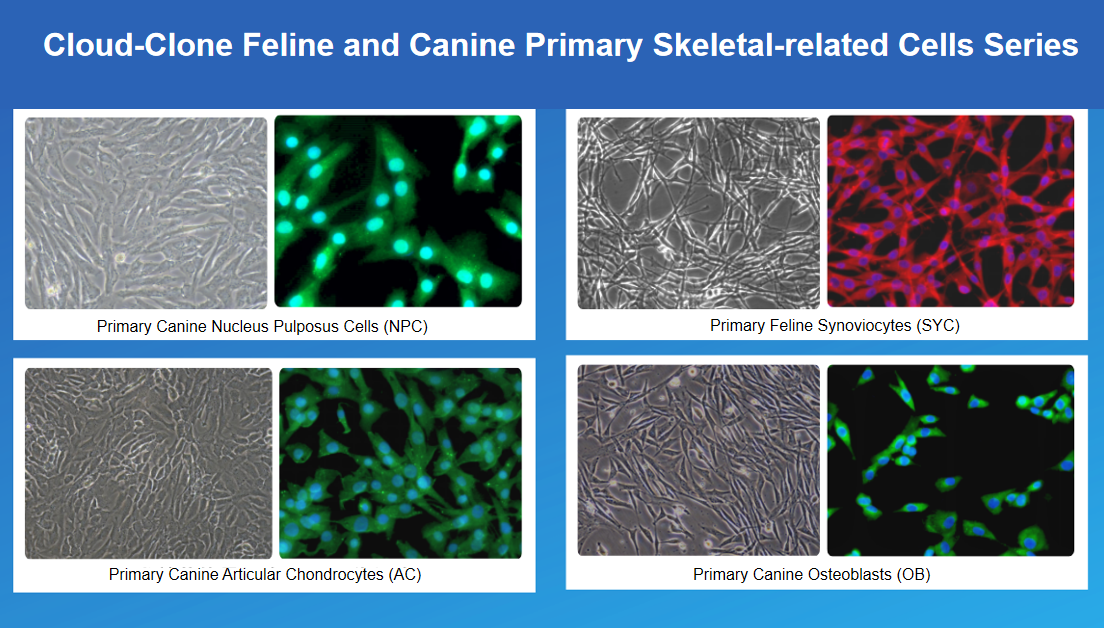
Musculoskeletal System Scalable batches of canine and feline synoviocytes, articular chondrocytes, skeletal-muscle cells, osteoblasts, tenocytes and nucleus pulposus cells are commercially available. These models enable mechanistic research and regenerative-medicine development for prevalent clinical conditions including osteoarthritis, intervertebral-disc degeneration, tendon injury and fracture repair.
Figure 3 Cloud-Clone Feline and Canine Primary Skeletal-related Cells Series
Beyond these three core systems, Cloud-Clone provides primary-cell models representing respiratory, digestive, urinary, reproductive, metabolic, ophthalmic and immune organs, alongside large-scale supplies of mesenchymal stem cells. This three-pillar, whole-organism coverage eliminates the need for researchers to assemble fragmented resources across multiple vendors.
From Local Laboratories to Global Markets: Cloud-Clone’s Companion-Animal Primary-Cell Footprint
As global suppliers prioritize human cell lines, Cloud-Clone has built a comprehensive resource bank for companion-animal primary cells. This achievement represents more than product expansion; it reshapes the global toolkit landscape for life-science research.
Cloud-Clone functions as a repository of standardized research components for global veterinary-drug discovery. Researchers avoid labor-intensive primary-cell isolation, unpredictable animal-tissue sourcing and problematic batch-to-batch variation. Every cell batch ships with a Certificate of Analysis (COA) and fluorescence validation images, ensuring consistent performance for identical catalog numbers.
These primary-cell products also serve as a living research bridge advancing the One-Health framework. Canine epilepsy, feline diabetes and canine osteosarcoma share highly homologous pathological mechanisms with corresponding human diseases. Cloud-Clone’s companion-animal primary-cell models empower global investigators to explore cross-species disease mechanisms and validate novel therapeutic candidates, supporting bidirectional translational progress between veterinary and human public-health research.
Cloud-Clone stands as a key contributor within global biotech value chains. The top five global animal-health enterprises (Zoetis, Merck, Boehringer Ingelheim, Elanco, IDEXX) collectively captured 40 % of market share in 2025, reflecting high industry concentration. Against this backdrop, Cloud-Clone leverages its differentiated portfolio covering ten species and worldwide delivery capabilities serving Europe, North America and the Asia-Pacific. The enterprise supports leading pharmaceutical and research institutes worldwide as a major global exporter of primary-cell products, establishing itself as an influential supplier within global pet-health R&D supply chains.
The global pet-health industry is transitioning from volume-driven expansion toward value-oriented innovation. Next-wave competition will center on breakthrough innovation: novel targeted therapeutics, precision diagnostic assays, as well as cell- and gene-therapy candidates. All such innovations depend upon reliable, reproducible living cell models as their experimental foundation.
When researchers in Germany record calcium transients in canine cardiomyocytes, when CRO teams in the United States deploy feline primary hepatocytes for veterinary-drug toxicity testing, and when doctoral candidates in Japan thaw canine adipose-derived mesenchymal stem cells from liquid-nitrogen storage, Cloud-Clone’s cell products quietly enable innovations across global pet-health research. This defines the meaningful position held by the “kingdom of companion-animal primary cells” within the evolving global pet-health research ecosystem.
About Cloud-Clone Corp.
Cloud-Clone Corp. is dedicated to the development and production of high-quality immunoassay reagents and detection solutions. With a focus on antibody engineering, multiplex assay development, and cross-platform compatibility, the company provides research tools designed to support precision medicine and advanced biomedical investigation globally. Our core products and services include the research and development of proteins, antibodies, ELISA kits, primary cells, and multiplex cytokine assay kits, as well as professional CRO services to fully meet the diverse needs of biomedical research and related fields.
For more information about Cloud-Clone Corp, visit www.cloud-clone.com.
CLOUD-CLONE CORP.(CCC)
Tel: 001-832-538-0970, 0086-27-8425-9552
Email: mail@cloud-clone.com, sales@cloud-clone.us
Visit us on social media:
LinkedIn: https://www.linkedin.com/company/cloud-clone-corp/
Instagram: https://www.instagram.com/cloudclonecorp2023/
TickTok: https://www.tiktok.com/@cloudclonecorp2026
SuKi Duan
CLOUD-CLONE CORP.WUHAN
Visit us on social media:
LinkedIn
Instagram
TikTok
X
Legal Disclaimer:
EIN Presswire provides this news content "as is" without warranty of any kind. We do not accept any responsibility or liability for the accuracy, content, images, videos, licenses, completeness, legality, or reliability of the information contained in this article. If you have any complaints or copyright issues related to this article, kindly contact the author above.
