

Changmei Technology's Advanced Rail Sleeper Pads Factory: Continuous Microcellular Forming in Combination with Enkamat
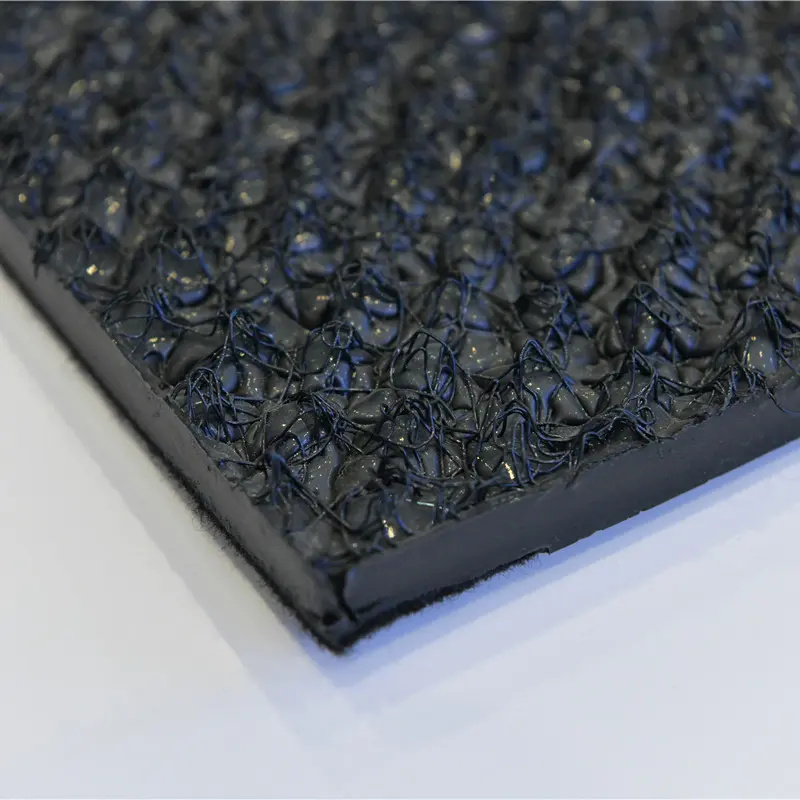

Continuous Microcellular Forming Stabilizes the Material Platform
The core advantage of continuous microcellular polyurethane forming lies in its ability to synchronize material foaming with continuous production rhythms. This integration ensures that the thickness, internal density structure, and elastic response of the sleeper pad are strictly controlled across a unified manufacturing platform. This highly engineered process stands in stark contrast to the simplistic logic of manually cutting standard rubber mats.
Microcellular polyurethane relies on its internal void structure to deliver consistent, compressible elasticity under dynamic track loads. Through the continuous forming process, large continuous expanses of the pad material can be produced under uniform conditions, before being specified, cut, and shaped according to the exact sleeper geometry and track requirements of a specific project.
To support this advanced material platform, the dedicated continuous foaming workshop utilizes an automated German production line. The current annual production capacity for the Microcellular Polyurethane Rail Track Elastic Sleeper Pad reaches 900,000 m². This provides engineering contractors and procurement teams with a clear, verifiable capacity metric for large-scale, project-based supply.
Rail-Seat and Full-Surface Pads Serve Different Contact Strategies
The distinction between rail-seat-only and full-surface sleeper pads is not merely a matter of dimensional size; it represents two fundamentally different load transfer strategies. While rail-seat pads concentrate isolation forces directly under the rail fastening points, full-surface pads cover the entire bottom surface of the concrete sleeper, utilizing a significantly larger contact interface to redistribute the forces exerted onto the ballast bed.
For full-surface configurations, the microcellular polyurethane foam can be combined with an open three-dimensional retention mesh (Enkamat) at the sleeper-facing side. This structure creates a better mechanical interlock with the sleeper interface. Compared to traditional under-rail pads, it offers superior bonding and prevents the pad from falling out. This is especially useful where the pad must maintain continuous contact across the sleeper bottom during transport, installation, and service.
Full-surface coverage expands the elastic interface across the entire sleeper bottom, making it particularly suitable for track environments where reducing localized contact pressure and improving the uniformity of sleeper-bottom force distribution are critical. This approach actively protects the ballast from concentrated mechanical degradation.
Designed for application on both 50 kg/m and 60 kg/m rails, these pads can simultaneously serve conventional railways and urban rail transit systems. This flexibility ensures that the appropriate coverage strategy can be selected based on specific track loads, existing ballast conditions, and overall project vibration reduction targets.
Thickness and Foundation Modulus Define the Customization Window
A sleeper pad's true engineering value lies in its adjustability. A thickness range of 7–12 mm combined with a static foundation modulus of 0.1–0.25 N/mm³ establishes the core customization window for these components. Changmei Technology allows thickness, shape, and performance to be customized according to specific line requirements, ensuring that the pad's physical geometry and vertical elasticity are perfectly synchronized.
The static foundation modulus directly influences the support flexibility of the sleeper under load. Project engineers must calculate this parameter in conjunction with the track's natural frequency, ballast conditions, and allowable vertical displacement. This rigorous calculation prevents the common misconception that a "softer" pad automatically equates to superior vibration reduction.
Because both thickness and modulus are designated as adjustable parameters, this highly parameterized customization can be seamlessly integrated with non-standard sleeper geometries, sharp track curves, turnout sections, and other localized track conditions that demand specialized support.
Larger Ballast Contact Changes Load Distribution and Wear Conditions
The engineering data confirms that the impact of the sleeper pad extends far beyond the pad itself, fundamentally altering ballast contact and load distribution. Under a specified stiffness condition (e.g., C=0.2 N/mm³), the contact area between the sleeper and the ballast can increase from a baseline of 5–8% up to 25–35%. Concurrently, the direct forces exerted onto the ballast are reduced by 10–25%.
This expansion of the contact area means that a significantly larger portion of the sleeper bottom participates in load bearing. This effectively mitigates the concentrated forces typically exerted by rigid, localized contact points, thereby slowing down ballast displacement, pulverization, and overall wear.
By adjusting the track's natural frequency to reduce vibration and noise, the product links improved ballast contact with long-term corrugation control in critical curve and turnout zones. This approach aligns vibration mitigation directly with the operational goal of enhancing track bed durability.
In-House Tooling Supports Non-Standard Sleeper Geometries
Changmei Technology connects the complex requirement of sleeper pad shape customization directly to its robust in-house tooling capabilities. The corporate mould engineering department is equipped with over 20 CNC machining centers, EDM machines, and wire cutting systems, allowing all rail-transit tooling to be executed internally. This vertical integration drastically reduces the company's reliance on external mould supply chains for non-standard pad geometries.
This mould engineering capability covers injection moulds, rubber moulds, SMC tooling, and specialized auto-core-pulling bush moulds. The breadth of this equipment demonstrates that the tooling platform is not dedicated solely to flat pads but is capable of supporting a wide array of non-standard, highly complex rail transit structures.
With an annual tooling output of 300 sets, the customization of sleeper pads—from the initial technical drawings and mould creation to the final continuous foaming production—follows a fully coordinated internal manufacturing pathway, ensuring tighter tolerances and faster prototyping.
Full-Surface Coverage Completes a Factory-to-Track Value Chain
From continuous microcellular forming and variable coverage configurations to parameter customization and in-house mould manufacturing, Changmei Technology has forged a complete capability chain. This chain connects advanced material science directly to the sleeper-ballast contact interface on the track. The current product specifications indicate a reference lead time of 7–30 days following order confirmation, providing a baseline for project scheduling.
Because the final lead time fluctuates based on specific order quantities and custom specifications, project procurement teams must finalize their technical parameters before committing to a production schedule. This ensures that standard delivery estimates are not conflated with the timelines required for non-standard product development.
The ultimate value of Changmei Technology’s offering lies in its ability to link customizable elastic materials and automated production capacity with verifiable track contact mechanics. Procurement professionals can further review the complete sleeper pad specifications and related vibration-control solutions by visiting https://www.changmeitech.com/.
Shaanxi Changmei Technology Co., Ltd.
Changmei Technology
email us here
Visit us on social media:
LinkedIn
Facebook
YouTube
TikTok
Legal Disclaimer:
EIN Presswire provides this news content "as is" without warranty of any kind. We do not accept any responsibility or liability for the accuracy, content, images, videos, licenses, completeness, legality, or reliability of the information contained in this article. If you have any complaints or copyright issues related to this article, kindly contact the author above.
