

NJU and PKU Team Achieves Single-Shot, High-Fidelity Lensless Dynamic Imaging
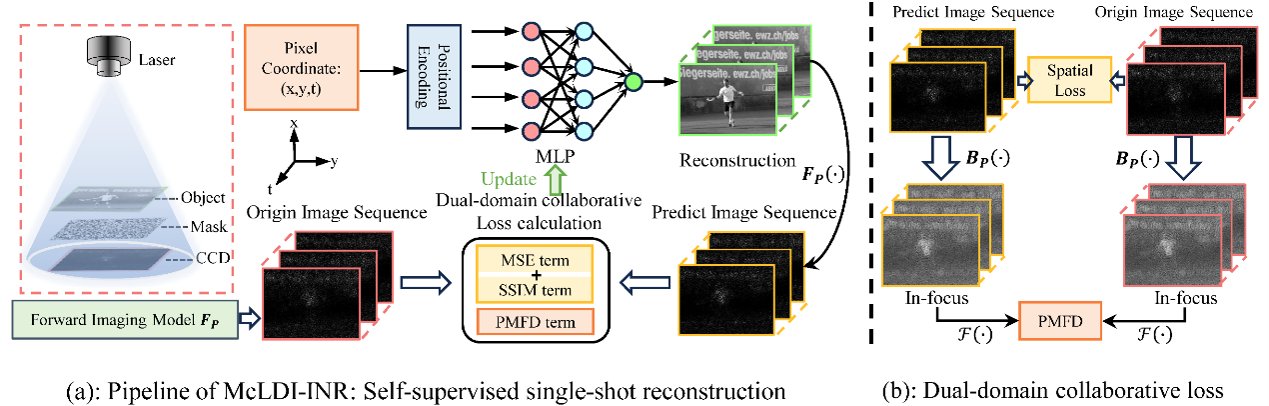
The illustration shows the reconstruction pipeline and the design of the dual-domain collaborative loss function.
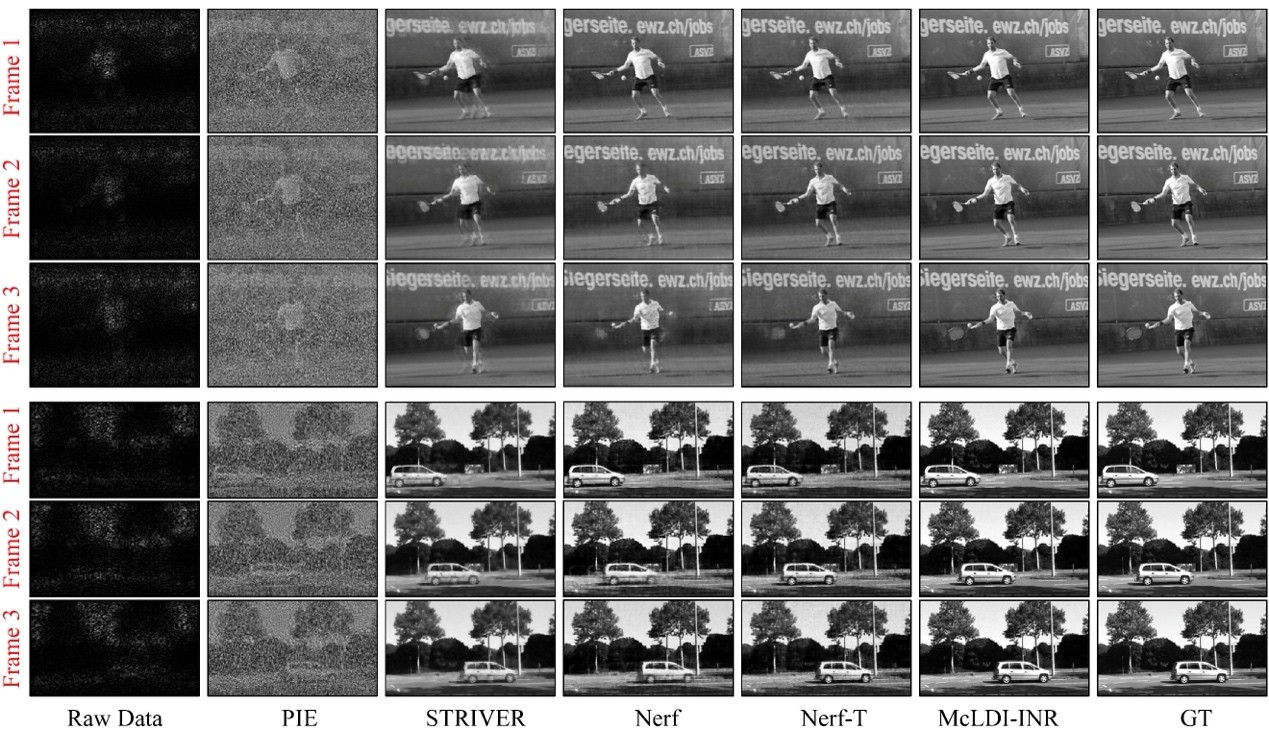
The illustration shows the advantages of the McLDI-INR method in complex dynamic scenarios.
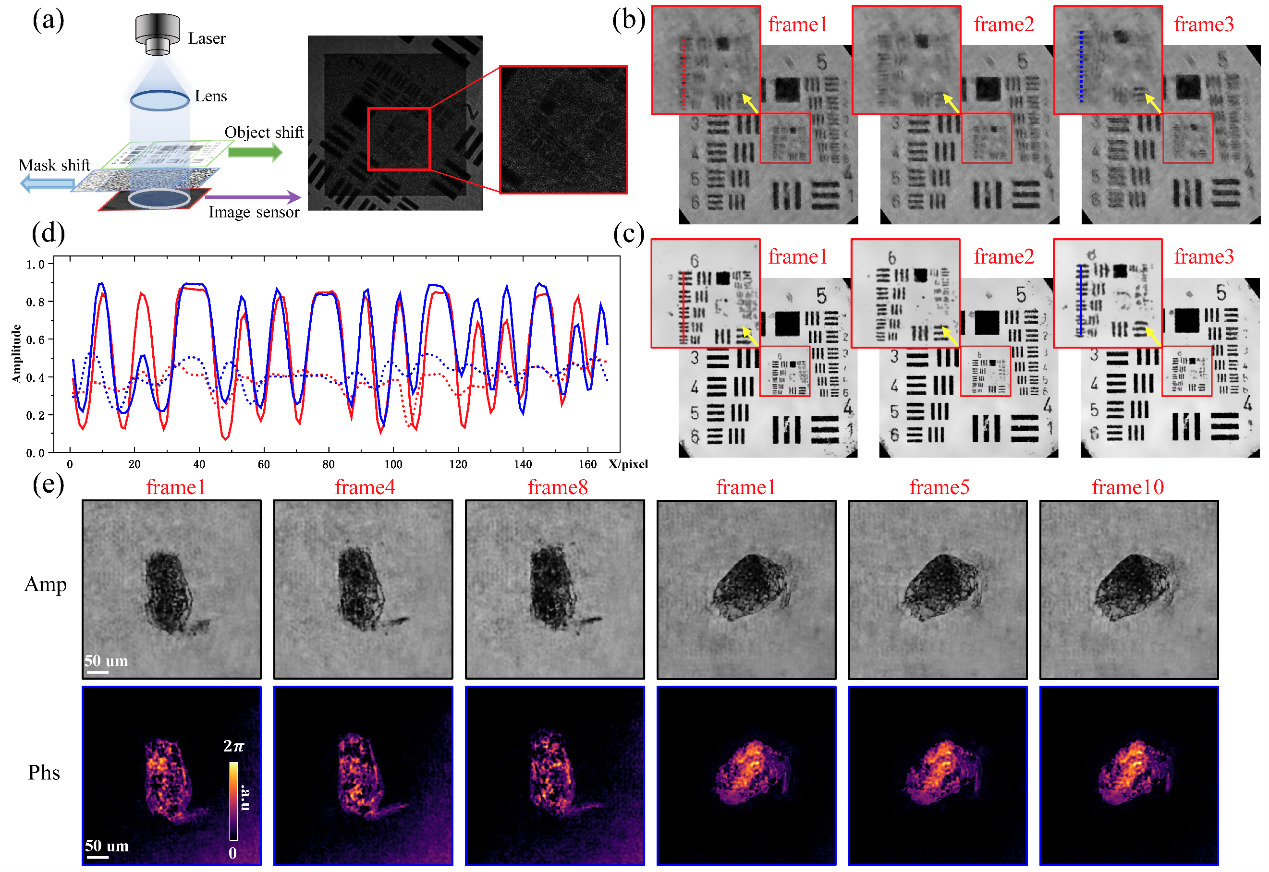
The experimental results show that McLDI-INR significantly improves the edge sharpness of the resolution target and mitigates motion blur.
NJU and PKU researchers combine physical modeling with neural representation to enable high-resolution dynamic scene reconstruction without conventional lenses.
SICHUAN, CHINA, August 24, 2026 /EINPresswire.com/ -- A joint research team from China explored a new paradigm integrating physical models with deep learning, proposing “McLDI-INR: Mask-constraint Lensless Dynamic Imaging by Dual-Domain Collaborative Implicit Neural Representation.” This framework overcomes lensless imaging’s conventional reliance on multiple acquisitions, strong prior assumptions, and high-precision physical models in dynamic scenarios. It enables lensless imaging systems to recover clearer, higher-resolution images of moving samples, paving the way for more flexible and practical lensless imaging applications.With the rapid development of smartphones, wearable devices, and portable medical diagnostic systems, increasingly stringent requirements have been placed on imaging systems: they are expected to provide clear images while remaining sufficiently compact and lightweight. Conventional cameras rely on lens-based imaging; however, optical lenses often limit further miniaturization and are susceptible to aberrations, chromatic dispersion, and other optical imperfections. Lensless imaging offers an alternative computational imaging paradigm. Instead of relying on complex lens assemblies, the sensor directly records the diffraction information of the modulated light field, and the image is subsequently “recovered” through computational reconstruction.
However, when the object being imaged is in motion, lensless imaging faces even greater challenges. The sensor typically records mixed and blurred diffraction patterns, and conventional methods often require multiple acquisitions or rely on strong prior assumptions. These limitations can lead to temporal information loss, motion blur, and missing fine details. In applications such as microscopy, live-sample observation, and dynamic biological process monitoring, achieving clear reconstruction of dynamic images from a single-shot measurement has therefore remained a long-standing challenge in the field.
Recently, a joint research team from Nanjing University, China, and Peking University, China, reported an advance in Intelligent Opto-Electronics (IOE). The study explores a new paradigm integrating physical models with deep learning. This framework provides a robust solution for addressing challenges described above. The central objective is to overcome the conventional reliance of lensless imaging on multiple acquisitions, strong prior assumptions, and high-precision physical models in dynamic scenarios. By doing so, it enables lensless imaging systems to recover clearer and higher-resolution images of moving samples, paving the way for more flexible and practical lensless imaging applications. The work, entitled “McLDI-INR: Mask-constraint Lensless Dynamic Imaging by Dual-Domain Collaborative Implicit Neural Representation,” was made available online on May 26, 2026, and published in Volume 2, Issue 2 of the journal IOE on June 30, 2026.
The research team first constructed a mask-constraint lensless dynamic imaging system, as illustrated in Fig. 1a. In this system, the incident optical field is modulated by a binary mask, enabling the otherwise difficult-to-interpret diffraction patterns to carry more physically interpretable information. On this basis, the team introduced an implicit neural representation approach, in which spatial and temporal coordinates are fed into a neural network to learn the complex-amplitude distribution of dynamic objects in continuous space and time. Unlike conventional methods, the proposed framework not only constrains the reconstruction at the sensor plane, but also designs a collaborative loss function in the spatial and frequency domains. By incorporating a physics-model-driven frequency-domain constraint, the framework enhances the recovery of high-frequency details, thereby effectively suppressing motion blur and reconstruction artifacts.
Simulation experiments demonstrate the advantages of the proposed method in complex dynamic scenarios, as shown in Fig. 2. For rapidly moving linear and nonlinear targets, McLDI-INR consistently produced reconstructions closer to the ground truth across diverse scenarios. In particular, it better preserved object contours, edge structures, and high-frequency texture details, confirming its superior capability for dynamic scene reconstruction. Real experiments further verify the practical value of McLDI-INR. As shown in Fig. 3, an actual mask-constrained lensless imaging system is built and dynamic reconstruction of a moving USAF resolution target and freely swimming rotifer samples is performed. The experimental results show that McLDI-INR significantly improve the edge sharpness of the resolution target and mitigate motion blur. In biological sample imaging, the method also successfully captures non-rigid motion details, such as tail contraction and displacement in rotifers, indicating its applicability to both regular moving targets and complex dynamic processes in living systems.
This study demonstrates that the deep integration of physical modeling and implicit neural representation can expand the capability boundaries of lensless imaging, enabling high-fidelity and high-spatiotemporal-resolution reconstruction of dynamic scenes without relying on conventional optical lenses. This achievement is expected to advance the development of miniaturized microscopy, portable biological detection, dynamic observation of living processes, and intelligent sensing devices. It also provides a new technical pathway for the future design of lensless imaging and computational optical systems.
Reference
Title of original paper: McLDI-INR: mask-constraint lensless dynamic imaging by dual-domain collaborative implicit neural representation
Journal: Intelligent Opto-Electronics
DOI: https://doi.org/10.67704/ioe.2026.260002
About Assistant Professor Bo Xiong from Peking University, China
Dr. Bo Xiong is an Assistant Professor and Ph.D. supervisor at the Institute of Medical Technology, Peking University. He received his Ph.D. in Engineering from Tsinghua University in 2022. During his doctoral studies, he conducted a research visit at the Janelia Research Campus of the Howard Hughes Medical Institute (HHMI) in the United States. His research mainly focuses on computational imaging, intelligent reconstruction algorithms, and image processing. He has led several research projects, including the General Program of the National Natural Science Foundation of China and the Special Funding Program of the China Postdoctoral Science Foundation. As first author or corresponding author, he has published more than 20 papers in journals and international conferences such as Light: Science & Applications, Laser & Photonics Reviews, Photonics Research, Intelligent Opto-Electronics (IOE), CVPR, and ECCV, and has been granted 12 Chinese invention patents. He received the Outstanding Doctoral Dissertation Award from the China Society of Image and Graphics, was selected for the Young Elite Scientists Sponsorship Program by the Beijing Association for Science and Technology, and serves as a young editorial board member of journals including Opto-Electronic Advances, BME Frontiers, and Chinese Optics Letters.
About Assistant Professor You Zhou from Nanjing University, China
Dr. You Zhou is an Assistant Professor and Ph.D. supervisor at the Medical School, Nanjing University. He received his Ph.D. degree from the Department of Automation, Tsinghua University in 2019. During his doctoral studies, he conducted a research visit at the Department of Biomedical Engineering, University of Connecticut, U.S. His research mainly focuses on computational optical microscopy and intelligent imaging algorithms. He has led several research projects, including the General Program of the National Natural Science Foundation of China, the Jiangsu Provincial Youth Fund, and the Jiangsu Young Science and Technology Talent Support Program. As first author or corresponding author, he has published more than 20 papers in journals and international conferences such as Laser & Photonics Reviews, Photonics Research, Intelligent Opto-Electronics (IOE), IEEE Transactions on Medical Imaging, ECCV, and AAAI. He has been granted seven Chinese invention patents and three U.S. patents. He serves as a young editorial board member of Chinese Optics Letters and BME Frontiers.
Funding information
The work was supported by the Jiangsu Association for Science and Technology (JAST) Young Elite Scientists Sponsorship Program (No. JSTJ-2025-730), National Natural Science Foundation of China (No. 62371006), and the Beijing Natural Science Foundation (No. 3242008).
Siyi Ma
Institute of Optics and Electronics, Chinese Academy of Sci
+86 19136186296
oej_publishing@ioe.ac.cn
Legal Disclaimer:
EIN Presswire provides this news content "as is" without warranty of any kind. We do not accept any responsibility or liability for the accuracy, content, images, videos, licenses, completeness, legality, or reliability of the information contained in this article. If you have any complaints or copyright issues related to this article, kindly contact the author above.
